Islamic Birthday Wishes: Duas & Messages for Muslims
Islamic Birthday Wishes: Heartfelt Duas, Messages, and Blessings for Every Muslim

Most people send a birthday message in under 30 seconds. Muslims who take the time to craft a sincere Islamic birthday wish are offering something far more valuable: a dua, a prayer made on behalf of someone else, that Islamic tradition says benefits both the sender and the recipient.
That is not a small thing. This guide gives you everything you need to write meaningful Islamic birthday wishes, from Arabic phrases and Quranic verses to tailored messages for family, friends, and milestone occasions.
What Are Islamic Birthday Wishes and Why Do They Matter
Islamic birthday wishes are faith-centered greetings that combine personal warmth with sincere supplication to Allah. Unlike generic birthday messages that celebrate the individual in isolation, these greetings place gratitude, humility, and dua at the center of the exchange.
When you craft a thoughtful Muslim birthday greeting, you are doing more than being polite. You are:
- Making dua for someone you care about
- Acknowledging that all blessings originate with Allah
- Strengthening your bond through shared faith and values
- Performing an act of worship that Islam explicitly rewards
This distinction matters in practice. A generic “Happy Birthday, have a great year!” message can feel hollow precisely because it centers the individual and nothing else. An Islamic birthday wish shifts that focus outward and upward, turning a social moment into a spiritual one.
According to a 2017 Pew Research Center survey, approximately 1.8 billion Muslims live across the globe, representing nearly 24 percent of the world’s population. Across these diverse communities, birthday acknowledgment practices vary widely, but the desire to express sincere, faith-centered blessings connects practicing Muslims everywhere.
The Significance of Birthdays in Islam: What Scholars Actually Say
The question of whether Muslims should celebrate birthdays is one scholars have debated for generations, and the honest answer is that qualified opinions differ.
Some scholars, particularly those in the Hanbali and Salafi traditions, advise against formal birthday celebrations, citing the absence of explicit prophetic precedent for such observances. Their concern is not with expressing gratitude but with adopting a ritualized celebration that has no basis in the Sunnah.
Other contemporary scholars, including many in the Shafi’i and Hanafi traditions, take a more permissive view. They see birthdays as culturally neutral occasions that become spiritually meaningful when approached with gratitude and prayer. Their reasoning draws on a broader principle in Islamic jurisprudence: anything not explicitly prohibited and not imitative of prohibited religious practices is permissible.
What virtually all scholars agree on is this:
- Expressing gratitude to Allah for another year of life is not only permissible but encouraged
- Reflecting on time passed and one’s relationship with Allah is always appropriate
- Praying sincerely for another Muslim on any occasion is an act of worship
The Prophet Muhammad (peace be upon him) is recorded in Sahih Muslim to have observed the significance of specific days as opportunities for worship and reflection. When you approach a birthday as a moment to thank Allah for His mercy and to pray for someone you love, you are acting squarely within the spirit of Islamic gratitude, regardless of where you stand on the celebration question.
The Role of Dua in Islamic Birthday Greetings
Dua occupies a central place in Islamic life, and understanding its role transforms how you think about writing birthday messages.
The Quran describes dua as “the essence of worship” (Sunan al-Tirmidhi, Hadith 3371). The Prophet Muhammad (peace be upon him) encouraged Muslims to make dua for one another regularly, and Islamic scholars emphasize that dua made for someone in their absence carries particular blessing. This is supported directly by a hadith in Sahih Muslim (Book 48, Hadith 65), where the Prophet said that when a Muslim makes dua for his brother in his absence, an angel responds: “Ameen, and may you have the same.”
What this means for you is significant. Every sincere Islamic birthday wish that contains a genuine prayer benefits both the person receiving it and you, the person sending it. You are not just crafting words. You are offering a gift with real spiritual value.
In practice, this changes your approach to writing these messages. Instead of thinking “What sounds nice?” you start thinking “What do I genuinely want Allah to grant this person?” That shift in intention is exactly what separates a Muslim birthday blessing from a routine social greeting.
Classic Arabic Phrases for Islamic Birthday Wishes
Arabic is the language of the Quran, and incorporating Arabic phrases into your Islamic birthday wishes adds authenticity, beauty, and spiritual depth that English alone cannot always replicate. Even a single Arabic phrase shows thoughtfulness and reverence for your shared faith.
The Most Widely Used Arabic Birthday Blessings
“Eid Milad Saeid” (عيد ميلاد سعيد) Direct translation: “Happy Birthday.” This is the most commonly understood Arabic birthday greeting across Arabic-speaking Muslim communities, particularly in Egypt, the Levant, and North Africa. Use it as a simple opening line before adding a more personal dua.
“Barakallahu fi Umrik” (بارك الله في عمرك) Direct translation: “May Allah bless your age (life).” This is one of the most beloved Islamic birthday wishes precisely because it invokes Allah’s blessing directly on the recipient’s entire life, not just the day itself. It is widely used across South Asian, Arab, and African Muslim communities and works in both written and spoken contexts.
“Zada Allahu barakatan fi hayatik” (زاد الله بركةً في حياتك) Direct translation: “May Allah increase blessings in your life.” This phrase suits milestone birthdays beautifully. When someone turns 30, 40, or 50, or when they are entering a significant new chapter, this dua carries extra resonance.
“Taqabbalallahu minna wa minkum” (تقبل الله منا ومنكم) Direct translation: “May Allah accept from us and from you.” Traditionally associated with Eid, some Muslims include this in birthday messages to express the hope that all good deeds performed throughout another year of life will be accepted by Allah.
How to Use Arabic Phrases If Arabic Is Not Your First Language
Do not let hesitancy about pronunciation stop you from including Arabic in your birthday messages. An imperfect but sincere attempt is meaningful, and most recipients will deeply appreciate the effort.
For “Barakallahu fi Umrik,” break the pronunciation down as: Ba-RA-ka-LA-hu fee UM-rik. If you already say “Barakallahu feek” in everyday conversation (meaning “May Allah bless you”), you are already most of the way there.
When writing digital messages, you can combine Arabic script, transliteration, and English translation together. For example: “Barakallahu fi Umrik (بارك الله في عمرك) – May Allah bless your life.” This approach gives your message cultural authenticity while ensuring every reader understands the meaning.
Quranic Verses That Work Beautifully in Birthday Messages
Incorporating a Quranic verse into your Islamic birthday wishes elevates the message in a way no other addition can. Here are three verses particularly suited to birthday contexts, each with guidance on when to use them.
Surah Ibrahim (14:7): For Gratitude and Reflection
“If you are grateful, I will surely increase you in favor.”
Use this verse when you want the birthday message to encourage the recipient to pause and reflect with thankfulness on the year passed. It is ideal for someone you know is spiritually reflective or who has experienced notable blessings during the year.
Surah Ash-Sharh (94:5-6): For Someone Who Has Faced Hardship
“For indeed, with hardship will be ease. Indeed, with hardship will be ease.”
This verse is a powerful comfort for someone who has navigated a difficult year. Including it in a birthday message acknowledges what they have been through without minimizing it, while pointing them toward hope rooted in divine promise.
Surah Al-Baqarah (2:286): For Resilience and Strength
“Allah does not burden a soul beyond that it can bear.”
This verse is meaningful for anyone who has carried heavy responsibilities during the year, whether as a parent, a caregiver, a student under pressure, or a professional facing significant challenges. It affirms their strength while attributing it to Allah’s wisdom.
Islamic Birthday Wishes for Family Members
Family occupies a sacred place in Islam, and birthday messages to family deserve the care that reflects that sacredness. The Prophet Muhammad (peace be upon him) consistently emphasized honoring parents, maintaining family ties (silat al-rahim), and expressing love to children. These values should shape the tone and content of your family birthday messages.
For Parents
When wishing your mother or father a blessed birthday, your message should reflect gratitude for their role in your life alongside your prayer for their health and spiritual well-being.
Example: “On your birthday, I ask Allah to grant you long life, good health, and His infinite mercy. You are among the greatest blessings He has given me. Barakallahu fi Umrik, and may every year ahead bring you closer to His pleasure.”
For a Spouse
A birthday message to your husband or wife is an opportunity to combine romantic warmth with Islamic sincerity, something the faith actively encourages within marriage.
Example: “May Allah bless you in this new year of your life and grant us many more years together in His grace. You make my deen stronger. Barakallahu fi Umrik.”
For Children
Birthdays are powerful moments to bless your child with intentional dua. The Quran records the dua of Ibrahim (peace be upon him) for his children in Surah Ibrahim (14:40): “My Lord, make me an establisher of prayer, and from my descendants. Our Lord, and accept my supplication.”
Example: “My beloved child, on your birthday I make dua that Allah fills your life with His light, grants you knowledge that benefits others, and keeps you steadfast on His path. You are one of the greatest gifts He has given me. Barakallahu fi Umrik.”
Islamic Birthday Wishes for Friends and Colleagues
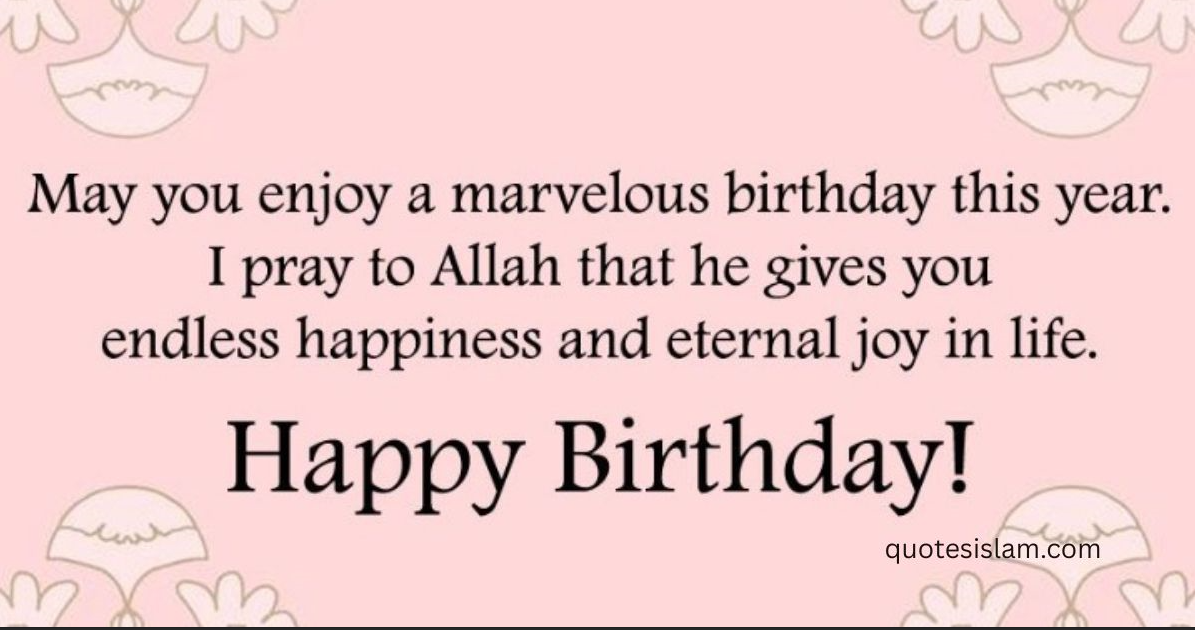
Not every birthday message is for family. Here is how to calibrate your Islamic birthday wishes for different relationships outside the home.
For a Close Friend
Close friendships in Islam carry real spiritual weight. The Prophet (peace be upon him) said: “A person is upon the religion of his close friend, so let each of you look at whom he befriends” (Sunan Abu Dawud, Hadith 4833). A sincere birthday dua for a close friend honors that bond.
Example: “JazakAllahu khayran for being a friend who makes me want to be better. On your birthday, I ask Allah to bless your life, ease your struggles, and grant you everything good in this world and the next. Barakallahu fi Umrik.”
For a Professional Contact or Colleague
The tone here should be warm but appropriately measured. A short, sincere Islamic greeting respects the professional context while still reflecting your faith.
Example: “Wishing you a blessed birthday. May Allah grant you continued success, good health, and His mercy in the year ahead. Barakallahu fi Umrik.”
For Someone Going Through a Difficult Time
Sometimes a birthday arrives during grief, illness, or hardship. In these cases, your Islamic birthday wish should prioritize comfort and dua over celebration.
Example: “I know this birthday comes during a hard season. I want you to know I am making dua for you. May Allah grant you ease after difficulty, healing where you need it, and the peace that only comes from Him. You are in my prayers.”
Islamic Birthday Duas for Milestone Birthdays and Special Occasions
Milestone birthdays, turning 18, 30, 40, or 60, deserve something more specific than a standard greeting. Tailoring your Islamic birthday wish to a person’s life stage shows genuine attentiveness and makes the dua feel personal rather than copied from a template.
For a 40th Birthday
Forty holds particular significance in Islamic tradition. It is the age at which Allah describes the believer reaching full maturity and the age at which many prophets received their missions. Surah Al-Ahqaf (46:15) includes a specific dua for this stage of life: “My Lord, enable me to be grateful for Your favor which You have bestowed upon me and upon my parents and to work righteousness of which You will approve and make righteous for me my offspring. Indeed, I have repented to You, and indeed, I am of the Muslims.”
Including this reference in a 40th birthday message transforms it from a routine greeting into a meaningful spiritual marker.
For a New Muslim Celebrating Their First Birthday Since Shahada
This is an often-overlooked occasion that deserves special attention. A new Muslim celebrating their first birthday since embracing Islam is, in a real sense, celebrating a rebirth. Your message should honor both their journey and their new identity.
Example: “This birthday is not just another year. It is your first as someone who has chosen Allah consciously and completely. May He bless every step of your journey, grant you knowledge and community, and keep your heart firm on His path. Barakallahu fi Umrik.”
For a Child’s First Birthday
A child’s first birthday is as much a celebration for the parents as for the child. Your Islamic birthday wish here should include a dua for the child’s future and an acknowledgment of the parents’ blessing.
Example: “MashaAllah, one full year of this precious life. May Allah protect your child, fill their path with knowledge and goodness, and make them a source of barakah for your family and the ummah. Barakallahu fi Umrik (عمرك في الله بارك).”
How to Write Your Own Islamic Birthday Wishes: A Practical Framework
You do not need to copy a template to write a meaningful Muslim birthday greeting. You need a clear structure and sincere intention. Here is a repeatable framework you can use for any recipient.
Step 1: Open with an Islamic greeting or Arabic phrase
Start with “Assalamu Alaikum” if appropriate to the relationship, or open directly with an Arabic birthday blessing such as “Barakallahu fi Umrik.”
Step 2: State your personal connection or appreciation
In one or two sentences, name something specific about the person. Generic praise feels hollow. Specificity feels real.
Step 3: Include a sincere dua tailored to their life stage
Think about what this person actually needs from Allah right now. Are they a student? Pray for knowledge. Are they a new parent? Pray for their child. Are they going through hardship? Pray for ease.
Step 4: Close with a Quranic verse or hadith reference (optional but powerful)
Select a verse that fits their situation from the options above, or find one that speaks to something specific in their life.
Step 5: End with “Ameen” or “Insha’Allah”
Closing with “Ameen” signals that your dua is sincere and complete. It also invites the reader to say Ameen for themselves, multiplying the spiritual effect of the message.
Common Mistakes to Avoid When Writing Islamic Birthday Wishes
The mistake most people make is copying a generic message and adding “Insha’Allah” at the end and calling it Islamic. That approach misses the point entirely.
Here are the most common errors and how to avoid them:
- Using religious phrases as decoration rather than intention. “MashaAllah” and “Insha’Allah” should reflect genuine acknowledgment of Allah’s will, not be dropped in for cultural color.
- Ignoring the recipient’s actual circumstances. A dua that does not connect to what the person is actually going through feels impersonal regardless of how many Arabic phrases it contains.
- Copying and pasting without reading. Recipients notice when a message is generic. Spend 60 seconds personalizing any template you use.
- Neglecting to say Ameen or invite the reader to do so. Closing a dua properly is part of Islamic etiquette and makes the spiritual intention clear.
Key Takeaways
Islamic birthday wishes center Allah in the greeting, replacing individual-focused celebration with gratitude, dua, and reflection.
Including a sincere dua in a birthday message is an act of worship that Islamic tradition says benefits both the sender and the recipient.
Arabic phrases such as “Barakallahu fi Umrik” and Quranic verses from Surah Ibrahim, Surah Ash-Sharh, and Surah Al-Baqarah add authentic spiritual depth to any message.
Tailoring your Muslim birthday blessing to the recipient’s life stage, whether they are a child, a parent, a new Muslim, or someone turning 40, makes the dua feel personal and genuine.
A sincere, specific, imperfect message always outperforms a polished but hollow one. Intention matters more than eloquence.
Frequently Asked Questions About Islamic Birthday Wishes
What are beautiful duas for someone’s birthday?
Pray that Allah grants them good health, strong faith, barakah, forgiveness, and success in this life and the Hereafter.
What do you say in Islam when it’s someone’s birthday?
You can say, “May Allah bless you with a long life in His obedience, good health, happiness, and abundant barakah. Ameen.”
What is the best short birthday prayer?
“May Allah bless your life with faith, peace, good health, and endless mercy. Ameen.”
Do Muslims wish happy birthday?
Yes, many Muslims exchange birthday wishes along with duas, although birthday celebrations and practices may vary among individuals and cultures.
How to wish a happy birthday Islamically?
Wish them well with a sincere dua, asking Allah to bless them with guidance, mercy, success, and happiness in this life and the Hereafter.
Conclusion
These Islamic birthday wishes include Quranic verses and authentic duas to help you share sincere prayers and blessings with your loved ones on their special day. They are designed to make your greetings more meaningful by combining love, gratitude, and sincere duas for Allah’s blessings.