What is Muharram? The Sacred Islamic New Year Explained
What is Muharram? The Sacred First Month of the Islamic Calendar
Over 1.8 billion Muslims worldwide recognise Muharram as one of the holiest periods in the Islamic year — yet it remains one of the most misunderstood months in the faith. If you have ever wondered what Muharram is, why it matters, and what actually happens during it, this guide covers everything: its definition, its sacred status, the pivotal events it commemorates, and how Muslims across different traditions observe it today.
Thank you for reading this post, don't forget to subscribe!What is Muharram? Simply put, Muharram is the first month of the Islamic Hijri calendar and one of the four sacred months in Islam. Understanding what is Muharram helps explain why millions of Muslims dedicate this month to worship, reflection, fasting, and remembering significant events in Islamic history.
What is Muharram? Definition, Meaning, and Origin
Muharram is the first month of the Islamic lunar (Hijri) calendar — a month explicitly designated as sacred in the Quran and described by Prophet Muhammad (peace be upon him) as “Shahr Allah,” the Month of Allah.
The word itself signals the month’s character before you know anything else about it. “Muharram” derives from the Arabic root haram, meaning forbidden or sacred. Historically, warfare and bloodshed were prohibited during this month — a convention that pre-dated Islam and was upheld and confirmed by Islamic teaching. The name is a declaration, not a label.
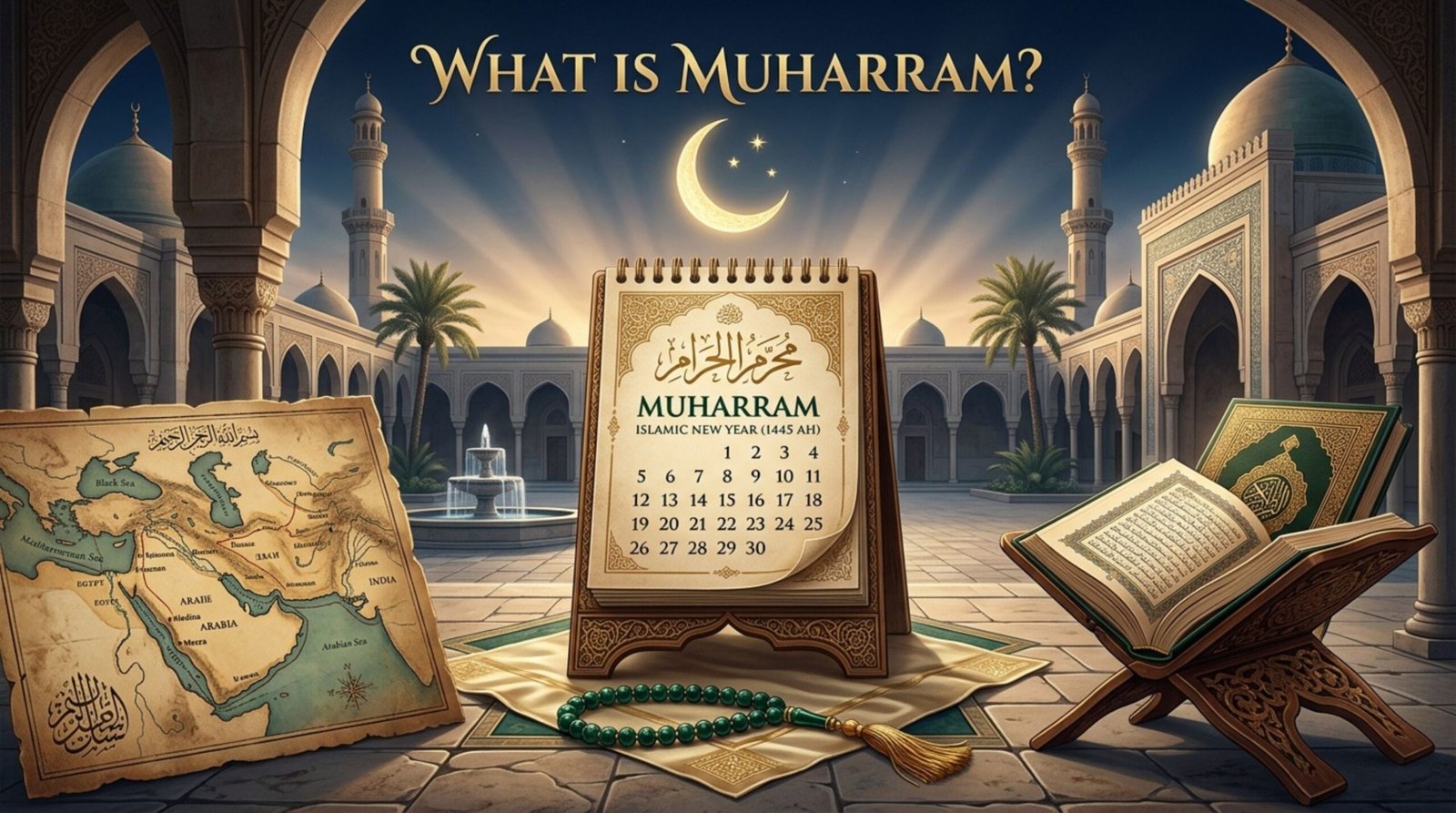
The Hijri calendar began in 622 CE, the year Prophet Muhammad (peace be upon him) migrated from Makkah to Madinah in an event known as the Hijrah. That migration became the founding event of the Islamic calendar and established Muharram as its opening month. Because the Hijri calendar follows the lunar cycle, Muharram shifts approximately 10–11 days earlier each year on the Gregorian calendar, travelling through the full solar year over a roughly 33-year cycle. Its date is not tied to a season — it belongs to all of them.
Where Muharram Sits in the Islamic Calendar
The twelve months of the Islamic calendar are:
- Muharram (sacred)
- Safar
- Rabi’ al-Awwal
- Rabi’ al-Thani
- Jumada al-Awwal
- Jumada al-Thani
- Rajab (sacred)
- Sha’ban
- Ramadan
- Shawwal
- Dhu al-Qadah (sacred)
- Dhu al-Hijjah (sacred)
Four of these months — Muharram, Rajab, Dhu al-Qadah, and Dhu al-Hijjah — are designated sacred (al-ashhur al-hurum) in Surah At-Tawbah (9:36). The Quran instructs believers not to wrong themselves or others during these months, a command that scholars across all major schools of Islamic jurisprudence interpret as a call to heightened moral accountability.
Muharram also marks the Islamic New Year. That said, if you expect celebrations resembling secular New Year observances — fireworks, parties, countdowns — you will find something entirely different. This New Year calls for prayer, self-assessment, and spiritual renewal. The contrast is intentional.
Many people ask, what is Muharram, and why is it different from other Islamic months? The answer lies in its unique religious status. Muharram is not only the beginning of the Islamic year but also a sacred month mentioned in the Quran, making it a special time for spiritual growth and self-improvement.
Why Muharram Is Considered Sacred in Islam
The sacred status of Muharram rests on three interconnected foundations.
Quranic Foundation
Surah At-Tawbah (9:36) explicitly identifies four sacred months and prohibits injustice within them. All major scholarly traditions — Hanafi, Maliki, Shafi’i, and Hanbali — agree that Muharram holds this designation. This is not a matter of scholarly debate; it is settled Islamic teaching with textual authority.
Prophetic Tradition
Prophet Muhammad (peace be upon him) referred to Muharram as “Shahr Allah” — the Month of Allah. This title is shared with no other month in the Hijri calendar. In prophetic narrations recorded in the Sahih collections, fasting in Muharram is described as the most virtuous voluntary fast after the fasts of Ramadan. That ranking places Muharram above Sha’ban and Rajab in terms of the spiritual reward attached to voluntary worship.
What is Muharram if not an opportunity for spiritual renewal? Islamic scholars describe this sacred month as a time to strengthen faith, increase voluntary worship, seek forgiveness, and renew one’s commitment to living according to the teachings of Islam.
Amplified Spiritual Consequences
In Islamic theology, sacred months function as periods of heightened moral weight. Sins carry heavier consequences; good deeds carry amplified reward. In practice, this means Muharram is one of the highest-yield periods on the Islamic calendar for worship, repentance, charity, and moral discipline. Treating it as a passive observance means leaving significant spiritual opportunity on the table.
The Day of Ashura: The Tenth of Muharram
The most significant day within Muharram — and arguably one of the most significant days in the entire Islamic year — is the Day of Ashura, the tenth of Muharram. Its importance layers multiple major events from prophetic and Islamic history into a single date.
To fully understand what is Muharram, it is essential to understand Ashura. The tenth day of Muharram has been associated with important events in Islamic history and is observed with fasting, remembrance, and worship by Muslims around the world.
The Salvation of Prophet Musa (Moses)
According to authentic hadith recorded in both Sahih al-Bukhari and Sahih Muslim, when Prophet Muhammad (peace be upon him) arrived in Madinah, he found the Jewish community fasting on the tenth of Muharram. They told him it commemorated the day Allah saved Prophet Musa (Moses) and the Children of Israel from Pharaoh by parting the Red Sea. The Prophet responded: “We have more right to Musa than you,” and instituted fasting on Ashura for Muslims. This response established a direct chain of prophetic solidarity across Abrahamic history.
Fasting on Ashura: What It Means and How to Do It
Fasting on Ashura is classified as mustahabb (highly recommended) in Sunni jurisprudence — not obligatory, but carrying significant reward. The Prophet (peace be upon him) said its reward is the expiation of sins from the previous year (Sahih Muslim, 1162).
Scholars recommend fasting on one of two combinations:
- The 9th and 10th of Muharram, or
- The 10th and 11th of Muharram
The addition of an adjacent day was intentional. The Prophet intended to distinguish Islamic practice from other traditions that fasted only on the 10th. If you fast only on the 10th, your fast is still valid and rewarded — but adding the 9th or 11th follows the complete prophetic recommendation.
The Battle of Karbala: What Happened and Why It Matters
When discussing what is Muharram, the events of Karbala cannot be overlooked. The sacrifice of Imam Hussain (RA) transformed Muharram into a lasting symbol of courage, justice, patience, and standing against oppression.
On the same date — the 10th of Muharram, 61 AH (680 CE) — one of the most defining tragedies in Islamic history unfolded on the plains of Karbala in present-day Iraq.
Imam Hussain ibn Ali (RA), grandson of Prophet Muhammad (peace be upon him) and son of Ali ibn Abi Talib (RA), refused to pledge allegiance to the Umayyad ruler Yazid ibn Muawiyah, whom he regarded as corrupt and unjust. His refusal was not a political calculation. It was a moral stand — a deliberate choice to bear personal cost rather than legitimise injustice through silence or compliance.
Imam Hussain (RA) and a small group of approximately 72 fighters, alongside members of his family, were intercepted at Karbala. They were denied access to the Euphrates River for three days, leaving them without water in the Iraqi desert heat. On the morning of Ashura, Imam Hussain (RA), his companions, and the male members of his family were killed by a vastly superior force. The women and children were taken captive to Damascus.
The mistake most people make when studying Karbala is treating it as a story of defeat. It was, in fact, a moral victory that outlasted every political power that opposed it. Mahatma Gandhi recognised this directly, stating: “I learned from Hussain how to achieve victory while being oppressed.” That observation — from a non-Muslim leader studying historical resistance — speaks to the universal resonance of Karbala’s moral logic.
Four Lessons from Karbala That Remain Relevant Today
- Standing for truth over power: Imam Hussain (RA) chose justice over self-preservation at a moment when capitulation would have been easy and survival-rational. The lesson is not that you should seek conflict — it is that integrity is not negotiable.
- Patience under extreme hardship: Three days without water, surrounded by enemies, facing near-certain death. The composure and faith demonstrated at Karbala remains one of the most documented examples of sabr (patience) in Islamic tradition.
- Courage as a moral obligation: The courage at Karbala was not recklessness. It was a deliberate refusal to validate injustice by remaining silent — a distinction worth sitting with.
- Faith as a foundation, not a fallback: Every historical account of Karbala records Imam Hussain (RA) in prayer and remembrance of Allah until his final moments. Faith was not what he turned to when things fell apart — it was what structured everything before that point.
How Muslims Observe Muharram: Sunni and Shia Practices
For anyone wondering what is Muharram in everyday Muslim life, the answer varies slightly between traditions but shares the same foundation of reverence, worship, remembrance, and reflection throughout the sacred month.
Muslim communities observe Muharram differently, and understanding those differences accurately matters more than flattening them into a single narrative.
Sunni Muslim Observances
For many Sunni Muslims, Muharram is primarily a month of increased worship, with Ashura as its focal point. Common practices include:
- Fasting on the 9th and 10th (or 10th and 11th) of Muharram
- Increased recitation and study of the Quran
- Additional voluntary prayers (nafl)
- Giving sadaqah (voluntary charity) to those in need
- Making dua (supplication) and seeking forgiveness
- Reflecting on Islamic history and the moral lessons of Karbala
Shia Muslim Observances
For Shia Muslims, Muharram is a period of mourning and communal remembrance centred on the tragedy of Karbala. Observances include:
- Attending majalis (religious gatherings) where scholars recount the events of Karbala in detail
- Wearing black clothing as a visible expression of collective grief
- Processions and communal lamentation (latmiyya)
- Heightened charity and acts of service, particularly on Ashura itself
The purpose of these commemorations is not ritual grief for its own sake. It is active, embodied remembrance of a moral stand — one that Muslims are called to reflect in their own lives and choices.
A Note on Unity
Here is the thing: the differences in how Sunni and Shia Muslims observe Muharram are real and deserve honest acknowledgement rather than being papered over. What both traditions share is the recognition that Muharram demands something of you — spiritual seriousness, moral reflection, and renewed commitment to the values Imam Hussain (RA) embodied and died defending.
Good Deeds Recommended During Muharram
If someone asks what is Muharram in practical terms, the answer also includes how Muslims spend this sacred month. Many increase their prayers, read the Quran, perform acts of charity, seek forgiveness, and strengthen their connection with Allah.
Muharram is one of the most spiritually productive periods on the Islamic calendar. Scholars across traditions recommend the following practices:
- Fasting, especially on Ashura (9th and 10th, or 10th and 11th)
- Regular and additional prayers beyond the five obligatory daily prayers
- Consistent Quran recitation and study — not just reading, but understanding
- Dhikr (remembrance of Allah) throughout the day
- Charity — particularly to orphans, the poor, and vulnerable communities
- Forgiving others and actively repairing broken relationships
- Avoiding sin — harmful speech, arguments, and moral compromise
- Sincere repentance (tawbah) and honest self-assessment
Every good deed performed in a sacred month carries greater spiritual weight. This is not a minor footnote — it is one of the most practical reasons to treat the first month of Muharram as an active spiritual investment rather than a passive acknowledgement.
Common Misconceptions About Muharram
Before exploring these misconceptions, it is worth revisiting what is Muharram. It is a sacred month recognised by all Muslims, and understanding its religious importance helps separate authentic teachings from common misunderstandings.
Misconception: Muharram is only significant for Shia Muslims. The sacred status of Muharram applies across all Islamic traditions. Fasting on Ashura is recommended in Sunni hadith literature, and the Quranic designation of Muharram as sacred applies to all Muslims without distinction.
Misconception: The Islamic New Year in Muharram is celebrated like secular New Year. Muharram marks the start of the Hijri year, but it is a time of reflection and worship — not festivity. Scholars generally advise against treating it like a secular celebration, as the month’s character is one of solemnity and spiritual renewal.
Misconception: Karbala was a political event, not a religious one. The events of Karbala were simultaneously historical, political, and deeply spiritual. Reducing them to politics misses the moral and theological core: Imam Hussain (RA) was willing to die rather than compromise his principles. That choice carries religious and universal human significance that extends far beyond 7th-century politics.
Key Takeaways
- Muharram is the first and one of four sacred months in the Islamic calendar, explicitly designated in Surah At-Tawbah (9:36) as a period demanding heightened moral accountability.
- The Day of Ashura (10th of Muharram) commemorates Allah’s salvation of Prophet Musa (Moses) and marks the martyrdom of Imam Hussain (RA) at Karbala in 680 CE.
- Fasting on Ashura — ideally on the 9th and 10th, or 10th and 11th — carries the prophetic reward of expiating the sins of the previous year (Sahih Muslim, 1162).
- Sunni and Shia Muslims observe Muharram differently, but both traditions recognise its sacred status and the moral imperatives it carries.
- The lessons of Karbala — standing for justice, demonstrating patience, choosing integrity over survival — remain universally relevant and are not limited to any single time or tradition.
By now, the question what is Muharram should be much clearer. It is far more than the first month of the Islamic calendar. It is a sacred period that encourages worship, moral discipline, remembrance of Ashura, and reflection on the timeless lessons of Karbala.
Conclusion
Ultimately, anyone asking what is Muharram should understand that it is much more than the beginning of the Islamic calendar. It is a month that encourages worship, justice, compassion, and remembrance of the timeless lessons that continue to inspire Muslims around the world.
In summary, what is Muharram? It is the first and one of the holiest months in the Islamic calendar, reminding Muslims of faith, justice, sacrifice, patience, and devotion to Allah. Understanding what is Muharram allows believers and non-believers alike to appreciate its profound spiritual and historical significance.
Frequently Asked Questions
What is the meaning of Muharram in Islam?
Muharram is the first month of the Islamic lunar calendar and one of four months designated sacred (al-ashhur al-hurum) in the Quran. The word derives from the Arabic root haram, meaning forbidden or sacred, reflecting the historic prohibition on warfare and injustice during this period. Prophet Muhammad (peace be upon him) specifically called it “Shahr Allah” — the Month of Allah — a title given to no other month.
What is the significance of the 10th of Muharram (Ashura)?
Ashura holds dual significance in Islamic tradition. It marks the day Allah saved Prophet Musa (Moses) and the Children of Israel from Pharaoh, and it is also the day Imam Hussain ibn Ali (RA), grandson of the Prophet, was martyred at Karbala in 680 CE. Fasting on Ashura is highly recommended in Sunni tradition, carrying the reward of expiating the previous year’s sins according to an authentic hadith in Sahih Muslim.
How is Muharram different from other Islamic months?
Muharram stands apart from other Islamic months for three key reasons: it is Qur’anically designated as sacred, it carries the unique prophetic title “Month of Allah,” and it contains Ashura — one of the most spiritually and historically significant days in the Islamic year. While Ramadan is obligatory in its fasting requirements, Muharram offers the highest-rewarded voluntary fast of the year, making it a uniquely high-value period for worship and moral renewal.