what are the similarities between christianity and islam
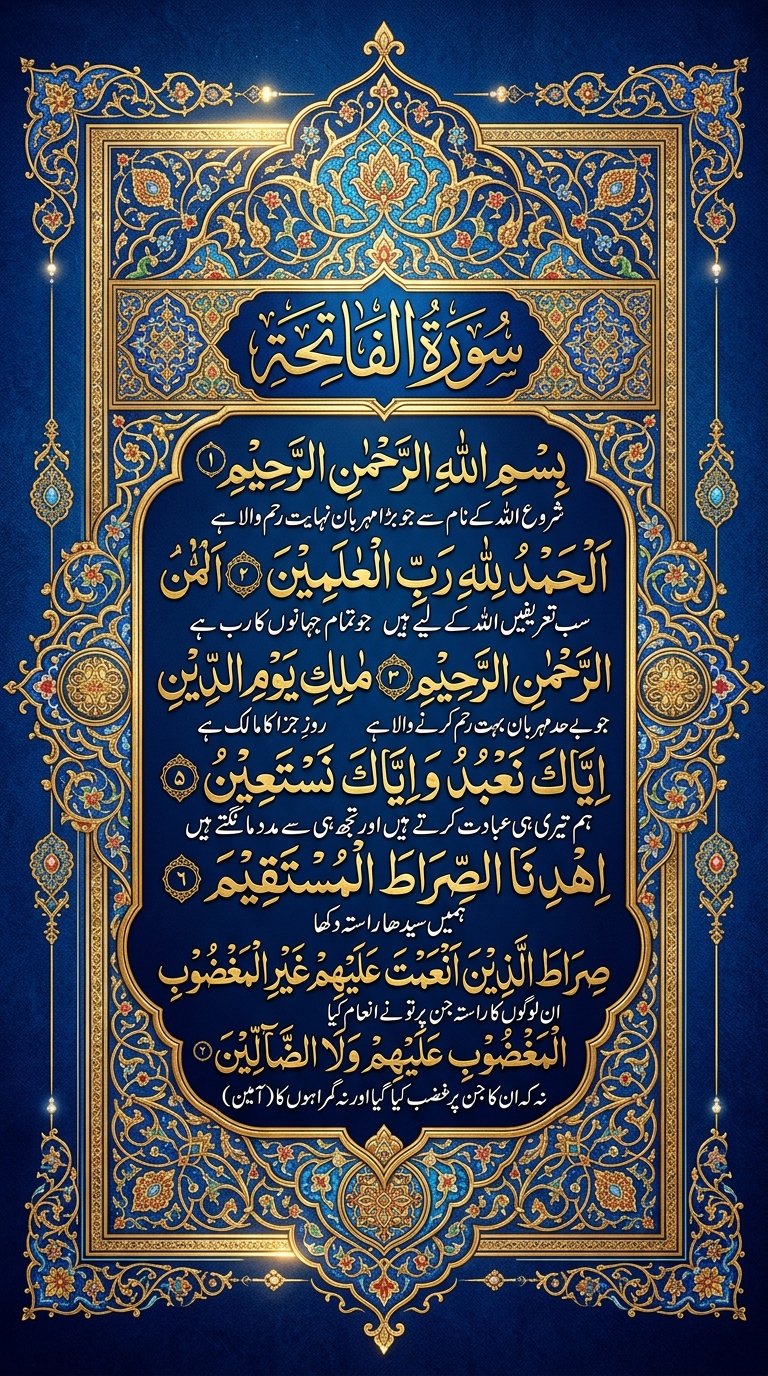
سورۃ الفاتحہ
بِسْمِ اللَّهِ الرَّحْمَٰنِ الرَّحِيمِ
الْحَمْدُ لِلَّهِ رَبِّ الْعَالَمِينَ
الرَّحْمَٰنِ الرَّحِيمِ
مَالِكِ يَوْمِ الدِّينِ
إِيَّاكَ نَعْبُدُ وَإِيَّاكَ نَسْتَعِينُ
اهْدِنَا الصِّرَاطَ الْمُسْتَقِيمَ
صِرَاطَ الَّذِينَ أَنْعَمْتَ عَلَيْهِمْ غَيْرِ الْمَغْضُوبِ عَلَيْهِمْ وَلَا الضَّالِّينَ
In the name of Allah, the Most Compassionate, the Most Merciful.
- All praise is due to Allah, Lord of all the worlds.
- The Most Compassionate, the Most Merciful.
- Master of the Day of Judgment.
- You alone we worship, and You alone we ask for help.
- Guide us to the straight path—
- The path of those upon whom You have bestowed Your favor,
- not of those who have earned Your displeasure, nor of those who have gone astray.
What Are the Similarities Between Christianity and Islam? A Complete Comparative Guide
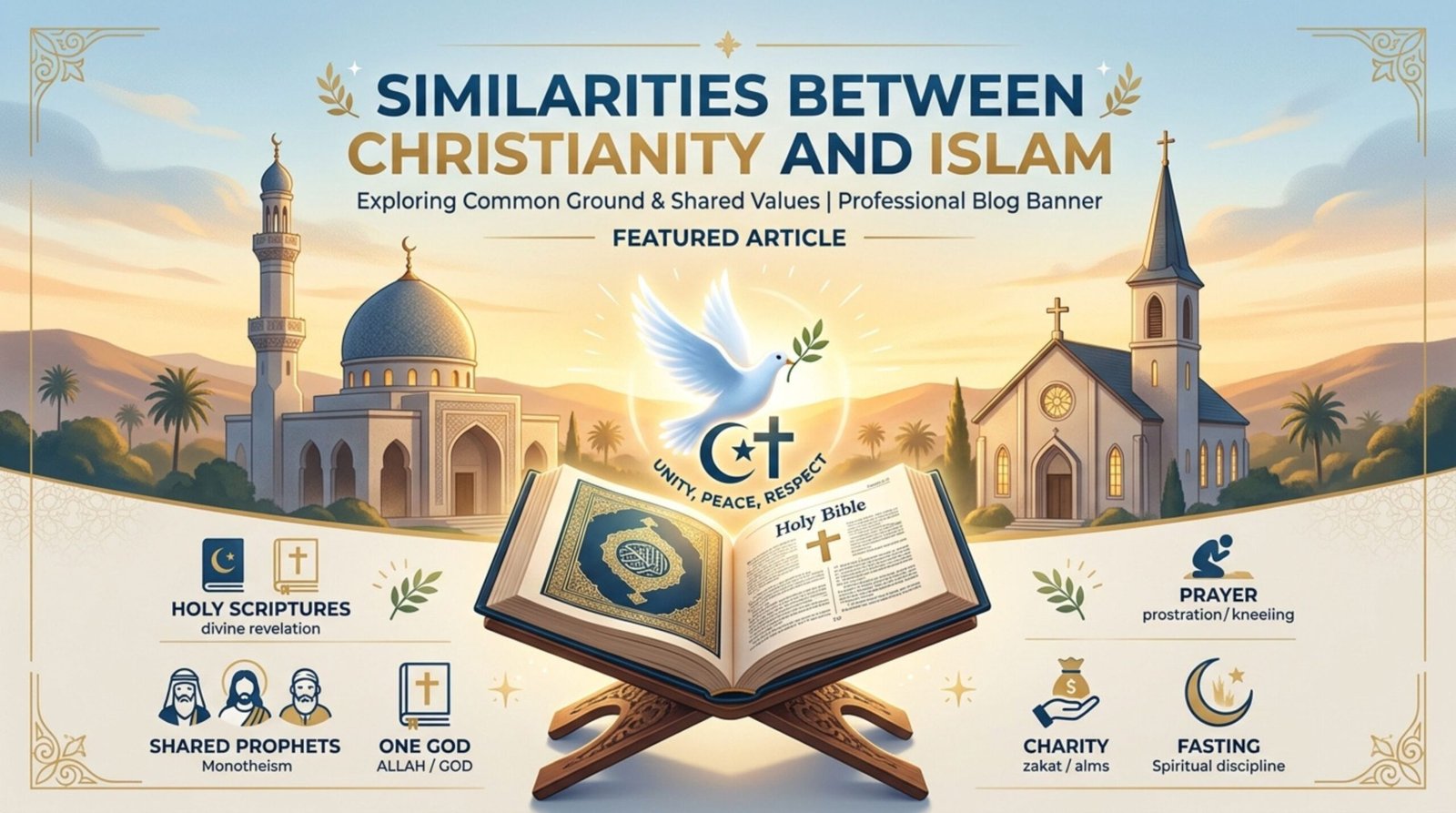
More than half of every person alive on Earth today follows one of two religions. Christianity and Islam — with approximately 2.4 billion and 1.9 billion adherents respectively — are not just the world’s largest faiths, they are also far more theologically connected than most people realise. If you’ve been asking what are the similarities between Christianity and Islam, the honest answer is: more than you’d expect, and the differences are often narrower than headlines suggest.
This guide breaks down those shared foundations — theologically, ethically, historically, and practically — so you can form an accurate, nuanced picture of how these two traditions overlap.
Many readers ask what are the similarities between Christianity and Islam because both faiths share a rich religious heritage and many common beliefs.
Why Understanding the Similarities Between Christianity and Islam Matters
Interfaith dialogue is not a feel-good exercise. It is one of the most practical tools available for reducing conflict, building cooperation, and fostering civic stability in diverse societies.
When 4.3 billion people belong to two faith traditions, and those traditions are routinely framed as opposing forces, the cost of ignorance is real — in political polarisation, in social mistrust, and in outright violence. According to Pew Research Center’s 2023 Global Religious Landscape report, Christianity and Islam together account for over 55% of the world’s population. Understanding what they share is not optional background knowledge. It is foundational literacy.
What this means for you: whether you are a student, an educator, a policymaker, or simply a curious person navigating a pluralistic world, understanding these shared roots gives you a sharper, more accurate framework for engaging with both traditions.
Shared Abrahamic Origins: Where Both Faiths Begin
The single most important structural similarity between Christianity and Islam is this: both are Abrahamic religions.This shared ancestry is one of the clearest answers to the question, what are the similarities between Christianity and Islam.
That term — Abrahamic — refers to the patriarch Abraham (Ibrahim in Arabic), whose covenant with God forms the theological foundation of Judaism, Christianity, and Islam alike. All three traditions trace their spiritual lineage to his faith, his obedience, and his willingness to submit completely to God’s will. Abraham’s near-sacrifice of his son, his rejection of idolatry, and his relationship with a singular, personal God are narratives that echo through every branch of this religious family.
Common Prophets and Patriarchs
Both Christianity and Islam recognise a shared cast of foundational figures:
- Adam — the first human, created by God
- Noah — recipient of divine warning and covenant
- Abraham — the patriarch of monotheistic faith
- Moses — the lawgiver who received divine revelation
- David — king, poet, and prophet
- Jesus — prophet (in Islam) and Son of God (in Christianity)
The Quran mentions 25 prophets by name, the majority of whom also appear in the Hebrew Bible and the Christian Old Testament. This is not coincidental overlap — it reflects a shared theological genealogy.
For many scholars, what are the similarities between Christianity and Islam can best be understood through their shared prophets and religious history.
Belief in One God: The Deepest Theological Common Ground
Both Christianity and Islam are strictly monotheistic. This is not a minor doctrinal footnote — it is the defining commitment of both traditions, and it separates them from polytheistic and pantheistic worldviews.When examining what are the similarities between Christianity and Islam, belief in one Creator remains the strongest common foundation.
Christianity articulates this through the doctrine of the Trinity: one God expressed in three persons — Father, Son, and Holy Spirit. Islam emphasises the absolute, undivided unity (Tawhid) of Allah, with no partners or subdivisions. Theologians debate whether these two formulations describe the same being. Dr. Miroslav Volf of Yale Divinity School — one of the most respected voices in Christian-Muslim dialogue — has argued that despite differing understandings of God’s nature, both traditions are fundamentally worshipping the same Creator God of Abraham.
How Both Scriptures Describe Divine Oneness
The verbal similarities are striking:
- Deuteronomy 6:4 (Old Testament): “The Lord our God, the Lord is one.”
- Surah Al-Ikhlas 112:1 (Quran): “Say: He is Allah, the One.”
Both traditions describe God using nearly identical attributes:
- Merciful — Allah as Al-Rahman; God described throughout the New Testament as rich in mercy
- All-Knowing — Allah as Al-Alim; God described as omniscient in Christian theology
- Just — Divine justice and final accountability are central to both
- Creator and Sustainer — both traditions affirm God as the author and upholder of all existence
These parallel descriptions are not superficial — they reflect a common theological inheritance stretching back to the same Semitic religious traditions.
Sacred Scriptures: Divine Revelation in Both Traditions
Another important aspect of what are the similarities between Christianity and Islam is the belief that God communicates with humanity through divine revelation.Both Christianity and Islam hold their sacred texts to be divinely revealed — not merely human wisdom, but direct communication from God.
Christians believe the Bible, comprising the Old and New Testaments, is the inspired Word of God, written through human authors under divine guidance. Muslims regard the Quran as the literal word of Allah, transmitted verbatim through the Angel Gabriel to the Prophet Muhammad over 23 years beginning in 610 CE in the Cave of Hira near Mecca.
Shared Stories Across Both Holy Books
Here is where the overlap becomes concrete. Several major narratives appear in both texts:
- Joseph and his brothers — detailed in Genesis and in Surah 12 (Yusuf), the Quran’s longest consecutive narrative
- Moses and the Exodus — central to both the Old Testament and multiple Quranic chapters
- Mary and the Annunciation — described in both the Gospel of Luke and Surah 19 (Maryam)
- Jesus’s miracles — affirmed in both the Gospels and the Quran
That last point is worth emphasising. Mary (Maryam) is the only woman mentioned by name in the entire Quran, and she has a full chapter dedicated to her. No woman receives more honourable treatment in the Quran than the mother of Jesus — a fact that surprises many people encountering it for the first time.
The Role of Jesus: The Most Significant Point of Overlap and Difference
Discussions about what are the similarities between Christianity and Islam often focus on Jesus because he is deeply respected in both traditions.
No figure illustrates both the similarities and the distinctions between these two religions better than Jesus.
What Christianity Teaches About Jesus
In Christianity, Jesus Christ is the incarnate Son of God — the second person of the Trinity — whose crucifixion and resurrection are the mechanism of human salvation. This is non-negotiable, central doctrine.
What Islam Teaches About Jesus
Islam regards Jesus (Isa in Arabic) as one of the five greatest prophets — alongside Noah, Abraham, Moses, and Muhammad. The Quran explicitly affirms:
- His miraculous, virgin birth (Surah 3:47)
- His role as a messenger of God
- His ability to perform miracles — healing the sick, raising the dead — by God’s permission
- His second coming before the Day of Judgment
The key difference is divinity: Muslims do not believe Jesus is God or the Son of God. But the respect accorded to him in Islamic theology is profound and unambiguous.
The Virgin Birth: A Rare Point of Full Agreement
Both traditions affirm the virgin birth without qualification. Luke 1:34–35 describes Mary conceiving without a human father. Surah 3:47 records the same miracle. In a world where the two religions are often defined by their disagreements, this is a striking example of shared doctrinal ground.
The virgin birth is another powerful example of what are the similarities between Christianity and Islam despite their theological differences.
Prayer, Fasting, and Worship: Parallel Spiritual Practices
Both Christianity and Islam are religions of practice — not just belief. The inner life must be expressed through disciplined external action.
Anyone researching what are the similarities between Christianity and Islam will notice that both religions emphasise worship and spiritual discipline.
Daily Prayer
- Islam: Salah — five daily prayers at set times, facing Mecca, performed with specific postures and recitations
- Christianity: No universal requirement for frequency, but Catholic Liturgy of the Hours, Orthodox prayer cycles, and evangelical devotional practice all emphasise regular, structured communication with God
Both traditions frame prayer as a direct conversation with God — not ritual performance, but relationship.
Fasting
- Islam: Ramadan — a full lunar month of fasting from dawn to sunset, one of the Five Pillars of Islam
- Christianity: Lent — 40 days of fasting and abstinence, particularly observed in Catholic, Orthodox, and Anglican traditions; fasting also appears throughout the Old and New Testaments as a spiritual discipline
Community Worship
Both religions anchor communal life around regular collective worship:
- Islam: Friday Jumu’ah prayers bring the Muslim community together weekly
- Christianity: Sunday services form the communal heartbeat of most Christian traditions
In practice, both functions serve the same purpose — accountability, collective devotion, and reinforcement of shared identity.
Shared Ethics: Moral Frameworks That Run Parallel
Ethical values provide another clear answer to what are the similarities between Christianity and Islam.
The ethical overlap between Christianity and Islam is extensive, and it is not accidental. Both drew from the same ancient Semitic moral tradition.
Honesty, Compassion, and Justice
Jesus’s Sermon on the Mount (Matthew 5–7) and the Prophet Muhammad’s Farewell Sermon (632 CE) both emphasise:
- Treating others with dignity and fairness
- Protecting the vulnerable
- Speaking truthfully
- Pursuing justice even at personal cost
Charity as Religious Obligation
Both religions institutionalise generosity:
- Islam: Zakat requires Muslims to donate 2.5% of savings annually — this is one of the Five Pillars, not optional
- Christianity: Tithing (giving 10% of income) and almsgiving are rooted in biblical teaching; 2 Corinthians 9:7 describes God loving “a cheerful giver”
Both traditions also share a strong emphasis on:
- The sanctity of human life from creation to death
- Family structure — marriage, parental responsibility, care for elders
- Prohibition of murder, theft, and dishonesty
Angels, the Afterlife, and Final Judgment
Angelic Beings
Both traditions affirm the existence of angels as divine messengers and servants of God. The Angel Gabriel — Jibril in Arabic — is the most prominent example of direct overlap:
- In Christianity: Gabriel announces Jesus’s birth to Mary (Luke 1:26–38)
- In Islam: Gabriel delivers the entire Quran to Muhammad over 23 years
This is the same angel, performing parallel functions of divine communication in both traditions.
Heaven, Hell, and Eternal Life
Both religions teach that:
- Human beings possess immortal souls
- Life on Earth is a test with eternal consequences
- Righteous believers receive eternal reward (Heaven, Paradise/Jannah)
- The unrepentant face eternal punishment (Hell, Jahannam)
Belief in the afterlife is also central when discussing what are the similarities between Christianity and Islam.
The Day of Judgment
The concept of a final Day of Judgment — in which God holds every person accountable for their deeds and intentions — is explicitly taught in both the Bible and the Quran. This shared eschatology provides both traditions with the same moral architecture: actions in this life carry eternal weight.
Mission and Outreach: Universal Faiths With a Global Call
Both Christianity and Islam understand themselves as universal religions — not ethnic or regional faiths, but messages intended for all humanity.
- Christianity: The Great Commission (Matthew 28:19–20) calls believers to “make disciples of all nations,” baptising and teaching
- Islam: Dawah — the call to invite others to Islam — is a communal responsibility, carried out through example, education, and respectful dialogue
Both traditions have produced extensive missionary movements across every continent, driven by the shared conviction that their message is not proprietary but universal.
Key Takeaways
- Both Christianity and Islam are Abrahamic monotheistic religions, sharing common patriarchs, prophets, and theological heritage rooted in the same ancient Semitic tradition
- Both traditions describe God using nearly identical attributes — merciful, all-knowing, just, and sovereign — despite differing on the nature of the Trinity
- Jesus is a central figure in both religions: divine in Christianity, a major prophet in Islam — and both affirm his virgin birth and miracles
- Both faiths institutionalise prayer, fasting, charity, and communal worship as core spiritual disciplines, not optional extras
- Shared ethics, eschatology, and a universal mission mean that Christianity and Islam have more structural common ground than popular discourse typically acknowledges
Conclusion
In conclusion, the answer to what are the similarities between Christianity and Islam extends far beyond a few shared beliefs. Both religions are connected through common prophets, moral values, worship practices, and belief in divine guidance. From their shared Abrahamic roots to their emphasis on prayer, charity, justice, and accountability before God, the similarities between Christianity and Islam reveal a significant common foundation. Understanding what are the similarities between Christianity and Islam can help foster greater respect, dialogue, and cooperation among people of different faiths in today’s interconnected world.
Frequently Asked Questions
Do Christianity and Islam worship the same God?
Both faiths worship the God of Abraham — the single Creator of the universe — and describe Him using nearly identical attributes. The theological difference lies in how God’s nature is understood: Christianity articulates God as a Trinity, while Islam insists on absolute divine unity with no divisions. Scholars like Dr. Miroslav Volf of Yale Divinity School argue that the shared Abrahamic heritage means both traditions are, at their core, addressing the same God — even if their theological frameworks differ significantly.
What are the similarities between Christianity and Islam regarding Jesus?
Both religions affirm that Jesus was born of a virgin, performed miracles by divine power, and will return before the end of time. The key difference is that Christianity treats Jesus as the divine Son of God and the mechanism of salvation, while Islam regards him as one of the greatest human prophets. Mary, his mother, holds extraordinary honour in both traditions — she is the only woman named in the Quran and has an entire chapter dedicated to her.
How are the moral teachings of Christianity and Islam similar?
Both religions share a remarkably parallel ethical framework: honesty, compassion, justice, protection of the vulnerable, and care for the poor are central to both. Charitable giving is formalised as a religious duty in both — through Zakat in Islam and tithing or almsgiving in Christianity. Both traditions also uphold the sanctity of human life, the importance of family, and the prohibition of murder, theft, and dishonesty as foundational moral commands.
What Are the Similarities Between Christianity and Islam?
What are the similarities between Christianity and Islam? Both religions share belief in one God, respect for prophets, sacred scriptures, prayer, charity, moral teachings, and accountability in the afterlife.
These shared beliefs provide a clear answer to what are the similarities between Christianity and Islam and explain why both faiths are often described as closely related Abrahamic religions.