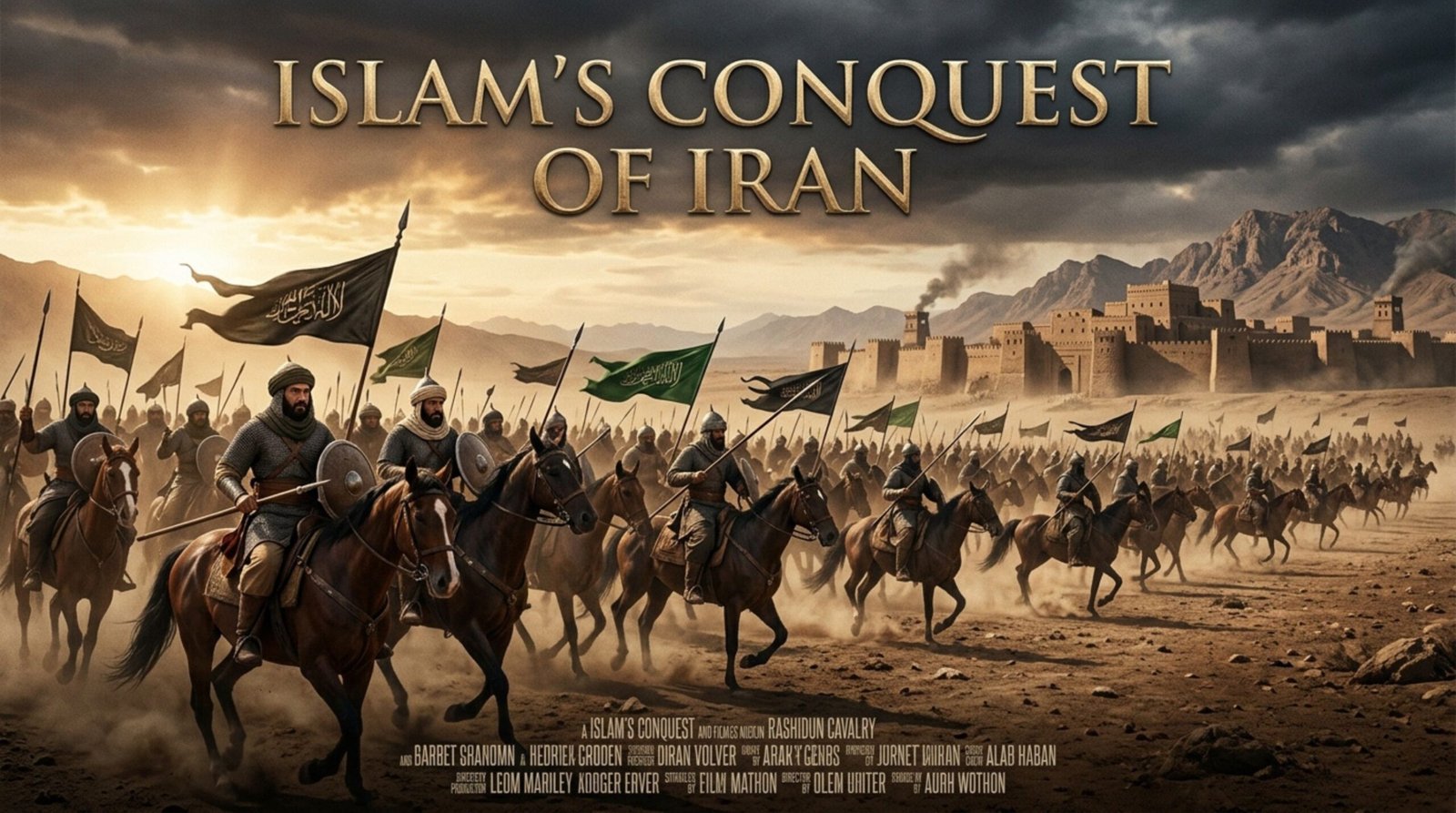
Islam’s Conquest of Iran: A Historical Overview
Few events in world history match the speed and permanence of what unfolded between 633 and 651 CE. In less than two decades, Arab Muslim armies dismantled a Persian empire that had endured for over four centuries — and Islam’s Conquest of Iran reshaped the religious, cultural, and political landscape of the ancient world in ways that still echo today. Understanding how this happened means looking beyond battlefield tactics to the structural fractures inside Sasanian Persia, the ideological momentum of early Islam, and the centuries-long cultural negotiation that followed.
Thank you for reading this post, don't forget to subscribe!Islam’s Conquest of Iran was not merely a military victory; it marked one of the most significant civilizational transformations in world history. The consequences of Islam’s Conquest of Iran reshaped the political, religious, and cultural landscape of the Middle East for centuries.
The Sasanian Empire on the Eve of Islam’s Conquest of Iran
The Sasanian Empire was not a civilization in obvious decline — until suddenly it was.
At its seventh-century peak, the empire governed between 20 and 30 million people across a territory stretching from Mesopotamia to Central Asia. Its capital, Ctesiphon — located along the Tigris River in present-day Iraq — rivaled Constantinople in administrative sophistication and architectural grandeur. Zoroastrianism served as the state religion, binding Persian imperial identity to a cosmic worldview that stretched back to the Achaemenid era. The empire produced extraordinary achievements in art, philosophy, and bureaucratic governance.
That said, beneath this surface of civilizational confidence, three converging crises were quietly hollowing out Sasanian power:
- Political instability: Between 628 CE and 632 CE, the Sasanian throne changed hands at least twelve times, driven by noble factionalism, assassination, and disputed succession. King Khosrow II’s murder in 628 CE triggered a collapse of central authority from which the dynasty never recovered.
- Military exhaustion: The Byzantine-Sasanian War of 602–628 CE inflicted hundreds of thousands of casualties on Sasanian forces, depleted the treasury, and devastated agricultural infrastructure in Mesopotamia — the empire’s economic heartland.
- Social discontent: Heavy wartime taxation, disrupted Silk Road trade networks, and localised famine eroded loyalty among the dahaqin (landed gentry) and peasant farmers. When Arab armies arrived, they encountered a population with diminishing reasons to fight for a distant imperial government.
The success of Islam’s Conquest of Iran was closely connected to the internal instability of the Sasanian Empire. Years of political turmoil and military exhaustion created conditions that allowed Islam’s Conquest of Iran to advance rapidly across Persian territory.
The common misconception is that the Arabs conquered a thriving superpower through sheer religious zeal. In practice, they conquered an empire already fracturing under its own accumulated weight.
The Rise of Islam and the Arab Military Campaigns
The Arab armies that crossed into Persian territory were not the fragmented tribal confederacies of earlier centuries. By 632 CE, the Prophet Muhammad had unified the Arabian Peninsula under Islam for the first time in history. Under Caliph Abu Bakr (632–634 CE), the Ridda Wars suppressed apostasy movements and consolidated Arab political unity, transforming tribal networks into a coherent military and ideological force capable of projecting power across vast distances with remarkable organizational efficiency.

Caliph Umar’s Strategic Vision
Under Caliph Umar ibn al-Khattab (634–644 CE), Arab military operations shifted decisively from opportunistic raiding to systematic territorial conquest. General Khalid ibn al-Walid had already secured early victories along the Euphrates, but Umar’s strategic reorientation committed Arab forces to the permanent annexation of Persian territory.
What distinguished this campaign from a simple series of raids was Umar’s methodical approach to consolidation. He established garrison cities — most notably Basra and Kufa in Iraq — that served simultaneously as:
- Logistical supply bases for advancing armies
- Recruitment and training centers for new Muslim fighters
- Administrative hubs governed by Islamic jurisprudence
By 636 CE, Arab forces controlled much of lower Mesopotamia, creating a strategic platform for the deeper penetration of the Iranian plateau. This was empire-building with long-term institutional intent, not opportunistic plunder.
Key Battles That Decided the Fate of Iran’s Conquest
Three military engagements effectively sealed Sasanian Persia’s fate. Each deserves careful attention because together they illustrate how quickly a civilizational order can collapse once its military backbone breaks.
The Battle of al-Qadisiyyah (636 CE)
The Battle of al-Qadisiyyah, fought near the Euphrates River in 636 CE, stands as the decisive turning point of Islam’s conquest of Iran. Arab forces commanded by Sa’d ibn Abi Waqqas defeated a numerically superior Sasanian army led by General Rustam Farrokhzad. Ancient sources claim the Sasanian force numbered between 100,000 and 120,000 soldiers, though modern historians favour significantly more conservative estimates. Rustam was killed during the engagement, and the Sasanian military hierarchy never recovered from the loss of its most capable commander.
The Fall of Ctesiphon (637 CE)
Within weeks of al-Qadisiyyah, Arab forces advanced on Ctesiphon and captured it in 637 CE. The psychological impact was enormous. The seizure of the Sasanian imperial treasury — including the legendary Bahārestan carpet, valued at millions of gold coins by Arab chroniclers — signalled to both populations that Sasanian authority had ceased to function as a viable protective institution. A capital is not just a city; it is a symbol. When Ctesiphon fell, the empire’s legitimacy collapsed with it.
The Battle of Nahavand (642 CE)
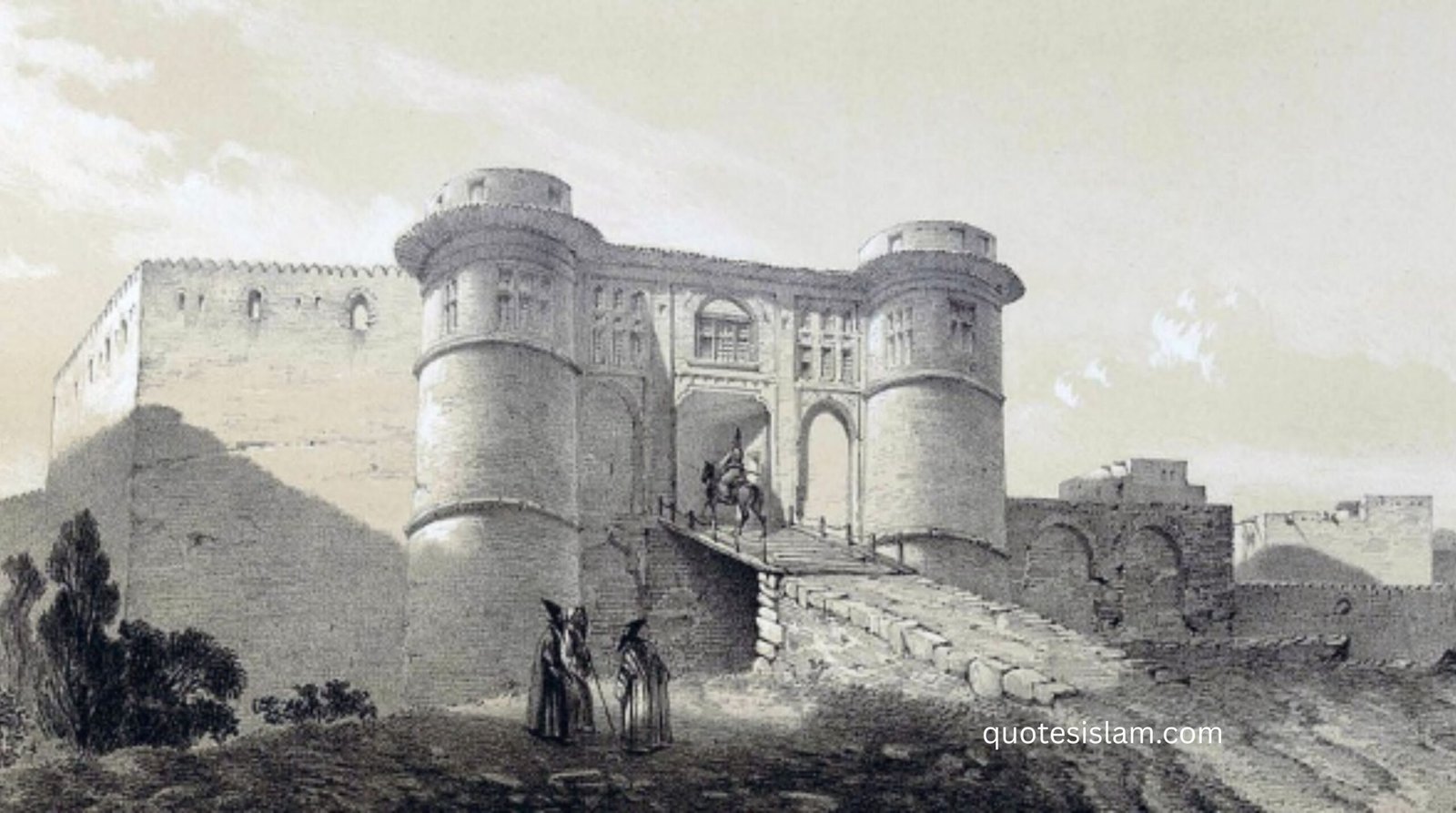
The Battle of Nahavand in 642 CE — called Fath al-Futuh (“Victory of Victories”) in Arab historical tradition — extinguished the last organised Sasanian resistance. The final Sasanian emperor, Yazdegerd III, fled eastward across the Iranian plateau and was murdered in Merv in 651 CE, ending the dynasty definitively. After Nahavand, Arab forces proceeded to conquer the Iranian plateau province by province over the following decades, encountering localised resistance but no coordinated imperial opposition.
The Process of Islamization Following the Arab Conquest of Persia
Here is where the standard narrative most often misleads people. The Arab conquest of Persia was a military event measured in years. The Islamization of Iran was a cultural process measured in centuries.
Gradual Conversion — What the Evidence Actually Shows
Historical evidence strongly contradicts the idea of mass forced conversion following the early Arab conquest of Iranian territory. Richard Bulliet’s landmark demographic study, Conversion to Islam in the Medieval Period (1979), provides the most rigorous quantitative analysis available:
- Approximately 10% of Iranians had converted to Islam by 700 CE
- That figure rose to roughly 50% by 900 CE
- A majority Muslim population likely did not exist in Iran until the late tenth century CE
Forced mass conversion was neither administratively feasible for early Arab governors nor consistent with Islamic legal frameworks governing conquered peoples. The jizya tax system — under which non-Muslims paid a poll tax in exchange for legal protection and religious autonomy — actually created a fiscal incentive for caliphal administrators to maintain, rather than eliminate, non-Muslim populations.
The Dhimmi System and Persian Religious Continuity
Zoroastrians, Jews, and Christians in conquered Iran were classified as dhimmis — protected non-Muslim subjects with defined legal rights and obligations. While the dhimmi framework imposed genuine social inequalities, it also provided institutional space within which Persian religious communities operated for centuries after the conquest. Zoroastrian fire temples continued functioning well into the ninth and tenth centuries CE across multiple Iranian provinces. Persian Zoroastrian communities survive to this day in Yazd and Kerman, as well as among the Parsi diaspora in India — a direct inheritance of communities that navigated the post-conquest world.
Persian Cultural Resistance and Strategic Adaptation
Iranians did not passively absorb Arab culture. Persian elites adapted strategically, channelling centuries of administrative expertise into Arab-Islamic governance structures and steadily reclaiming cultural ground. The Shu’ubiyya movement of the eighth and ninth centuries CE was a sophisticated intellectual assertion of Persian cultural equality with Arab Muslims — producing poetry, historiography, and philosophical literature that explicitly celebrated Iranian heritage within an Islamic framework.
This is the nuance most general histories miss: the Arab conquest of Iran did not produce cultural erasure. It produced cultural negotiation, and Iranians were skilled negotiators.
Although Islam’s Conquest of Iran ended Sasanian rule, it did not erase Persian identity. Instead, Islam’s Conquest of Iran initiated a long process of cultural adaptation that eventually produced a unique Persian-Islamic civilization.
The Lasting Legacy of Islam’s Conquest of Iran on Persian Identity
How Iranians Preserved Their Language Against Arabisation
Despite Arabic becoming the dominant language of religion, law, and science across the caliphate, the Persian language not only survived — it eventually flourished in a richer form. The poet Rudaki (c. 858–941 CE), widely credited as the father of classical Persian literature, wrote in a language that consciously incorporated Arabic vocabulary while preserving Persian grammatical structure and literary sensibility. His work signals the completion of a two-century cultural synthesis, not a capitulation.
By the tenth century CE, the Samanid dynasty in eastern Iran actively patronised Persian-language literature and scholarship, creating the institutional conditions for what historians now call the Persian Renaissance. Works like Ferdowsi’s Shahnameh (completed c. 1010 CE) — a 60,000-couplet epic celebrating pre-Islamic Persian kings — represent one of the most remarkable acts of cultural preservation in literary history.
The Birth of Persian-Islamic Civilisation
Historians Richard Frye and Hugh Kennedy have both argued that the Arab conquest of Iran ultimately produced a synthesis rather than a simple replacement. Persian administrative traditions, philosophical frameworks, and aesthetic sensibilities permeated the Abbasid Caliphate from the eighth century onward. Persian scholars, physicians, and poets shaped the Islamic Golden Age as fundamentally as Arab ones. Figures such as Ibn Sina (Avicenna), al-Biruni, and al-Khwarizmi — all of Persian origin — defined the intellectual character of medieval Islamic civilisation.
The mistake many people make is framing the conquest of Iran as a story of loss. It was also a story of transformation — one in which Persian civilisation absorbed a new religious framework and used it to produce something genuinely new.
The Historical Importance of Islam’s Conquest of Iran
The historical importance of Islam’s Conquest of Iran extends far beyond the fall of the Sasanian Empire. Islam’s Conquest of Iran transformed political institutions, reshaped regional power structures, and influenced the development of Islamic civilization for centuries. Many historians regard Islam’s Conquest of Iran as one of the most consequential events in Late Antiquity because it connected Persian traditions with the expanding Islamic world.
The legacy of Islam’s Conquest of Iran can be seen in literature, administration, science, and religious thought. While Islam’s Conquest of Iran brought major political changes, it also created opportunities for cultural exchange and intellectual growth. The long-term impact of Islam’s Conquest of Iran continued to shape Persian society throughout the medieval period and beyond.
Even today, discussions about Islam’s Conquest of Iran remain important for understanding the evolution of Iranian identity, Persian culture, and the wider history of the Middle East. The enduring influence of Islam’s Conquest of Iran demonstrates how a military conquest can produce lasting cultural and intellectual transformations.
Conclusion
The story of Islam’s Conquest of Iran is far more complex than a simple tale of military expansion. Islam’s Conquest of Iran transformed the ancient Persian world while also preserving many elements of Persian language, literature, and intellectual life. The enduring legacy of Islam’s Conquest of Iran can still be seen in modern Iranian culture and the broader Islamic world.
Key Takeaways
- Islam’s Conquest of Iran succeeded as much because of Sasanian internal collapse — political instability, military exhaustion, and social discontent — as because of Arab military superiority.
- The three decisive engagements — al-Qadisiyyah (636 CE), the fall of Ctesiphon (637 CE), and Nahavand (642 CE) — dismantled organised Sasanian resistance within a single decade.
- Islamization was a gradual, centuries-long demographic process: fewer than half of Iranians had converted to Islam by 900 CE, according to Bulliet’s demographic analysis.
- The dhimmi system provided legal protection for Zoroastrian, Jewish, and Christian communities, enabling Persian religious continuity for centuries post-conquest.
- Rather than erasing Persian identity, the Arab conquest triggered a cultural synthesis that produced Persian-Islamic civilisation — one of history’s most enduring intellectual traditions.
Frequently Asked Questions
Why did the Sasanian Empire fall so quickly to Arab Muslim armies?
The Sasanian Empire’s rapid collapse resulted from a combination of internal and external pressures, not Arab military superiority alone. Twelve throne changes in four years (628–632 CE), combined with the economic devastation of three decades of Byzantine-Sasanian warfare, left the empire politically fractured and militarily depleted before Arab forces crossed the border. The Battle of al-Qadisiyyah in 636 CE delivered the fatal blow to what was already a structurally weakened institution.
Were Iranians forced to convert to Islam after the Arab conquest?
No — the historical evidence does not support mass forced conversion following the Arab conquest of Persia. Richard Bulliet’s demographic research estimates that only about 10% of Iranians had converted to Islam by 700 CE, suggesting conversion was a gradual, largely voluntary process driven by social and economic incentives over two to three centuries. Early Islamic law explicitly protected non-Muslim dhimmi communities, and Zoroastrian fire temples continued operating in Iran well into the tenth century CE.
How did the Arab conquest of Iran affect the Persian language and culture?
The Arab conquest did not destroy Persian language or culture — it transformed them. Arabic became the language of religion and administration, but Persian survived as a literary and spoken language and re-emerged powerfully in the ninth and tenth centuries under Samanid patronage. Poets like Rudaki and Ferdowsi consciously preserved Iranian identity within an Islamic framework, and Persian scholars shaped the intellectual core of the Islamic Golden Age. The conquest ultimately produced Persian-Islamic civilisation, one of history’s richest cultural syntheses.