Islamic Quotes About Life: Timeless Wisdom From the Quran and Hadith
Islamic quotes about life have guided believers, scholars, and spiritual seekers for over 1,400 years — and their relevance has never faded. Rooted in the Holy Quran and the authenticated sayings of Prophet Muhammad (PBUH), these Islamic quotes about life continue to shape how millions of Muslims navigate love, loss, purpose, and perseverance. Whether you are facing hardship, seeking clarity, or simply looking for daily inspiration, the wisdom found in these Islamic quotes about life offers profound answers that transcend time, culture, and circumstance For many Muslims, Islamic quotes about life serve as daily reminders of faith, hope, and purpose.
Why Islamic Quotes About Life Still Resonate Across the World
Islam is the second-largest religion in the world, with approximately 1.9 billion followers across 49 Muslim-majority countries, according to the Pew Research Center. Yet the reach of Islamic wisdom extends far beyond religious boundaries. Scholars, philosophers, and motivational thinkers from diverse backgrounds have drawn on Quranic verses and Hadith literature for centuries — not because it is fashionable, but because it works.
The enduring appeal of Islamic life wisdom lies in its directness, depth, and universality. These teachings speak to the core of the human experience — suffering, gratitude, hope, and the pursuit of meaning — with a clarity that resonates across generations. You do not need to be a theologian to feel the weight of a verse that tells you your burden will never exceed your capacity to carry it.
How These Teachings Address Modern Challenges
Modern life brings relentless stressors: financial pressure, relationship breakdown, mental health crises, and existential uncertainty. Islamic wisdom addresses each of these with remarkable precision. The Quran, revealed over 23 years to Prophet Muhammad (PBUH), covers everything from personal conduct to societal justice. Its teachings remain as applicable today as they were in 7th-century Arabia — a testament not to coincidence, but to the universality of its source.
The mistake most people make when approaching these quotes is treating them as decorative captions. In practice, these are living principles — frameworks for decision-making, emotional regulation, and long-term purpose.
These Islamic quotes about life are not just spiritual reminders — they provide practical guidance for handling stress, relationships, emotional struggles, and personal growth in modern society.
Islamic Quotes About Life From the Holy Quran
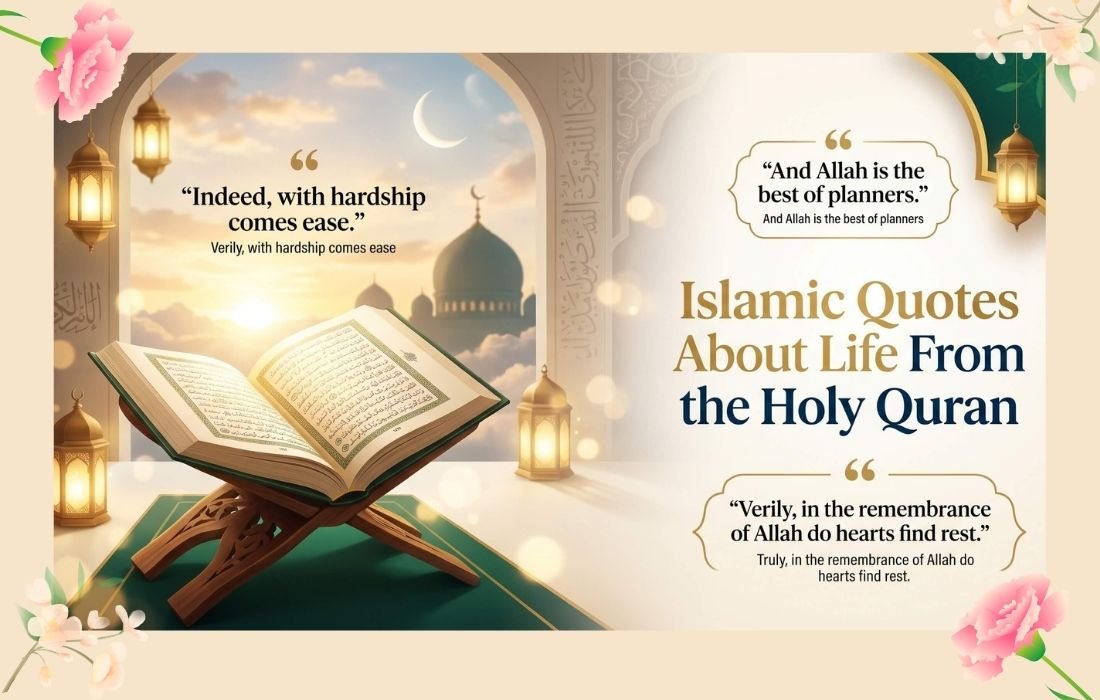
Some of the most powerful Islamic quotes about life come directly from the Quran, offering timeless lessons about faith, patience, gratitude, and purpose.
The Quran establishes the fundamental purpose of human existence with extraordinary clarity — and no collection of Muslim life wisdom is complete without it.
Quranic Verses on Life’s Purpose and Value
In Surah Adh-Dhariyat (51:56), Allah states:
“And I did not create the jinn and mankind except to worship Me.”
This single verse reorients the entire conversation about what a successful life looks like. According to the Quran, success is not measured by material accumulation but by conscious, intentional connection to the Creator. That shift in perspective alone can transform how you approach every decision you make.
Another foundational verse appears in Surah Al-Baqarah (2:286):
“Allah does not burden a soul beyond that it can bear.”
This Quranic quote on life has provided comfort to countless Muslims during unbearable circumstances — grief, illness, poverty, isolation. It does not promise that life will be easy. It promises that you are already equipped for whatever arrives.
Quranic Wisdom on Patience, Gratitude, and Trust
Surah Az-Zumar (39:10) states:
“Indeed, the patient will be given their reward without account.”
This verse elevates patience — known in Arabic as sabr — to one of the highest virtues in Islamic life. That is not merely spiritual rhetoric. A 2019 study published in the Journal of Positive Psychology found that patience is strongly associated with greater well-being and life satisfaction, reinforcing what the Quran affirmed fourteen centuries earlier.
On the subject of gratitude, Surah Ibrahim (14:7) declares:
“If you are grateful, I will surely increase you in favor.”
Gratitude (shukr) is mentioned over 60 times in the Quran, according to classical Quranic indices — a frequency that reflects its central importance in Islamic psychology, not ornamental repetition. This divine promise frames gratitude not merely as politeness but as a mechanism for genuine abundance: spiritual, emotional, and material.
Understanding the Deeper Meaning Behind Sacred Quranic Words
Quranic verses are rarely surface-level statements. Classical Islamic scholars, including Imam Al-Ghazali (1058–1111 CE), dedicated lifetimes to unpacking their layered meanings through the discipline of tafsir — Quranic commentary that integrates historical context, Arabic linguistics, and jurisprudence. Engaging with these quotes at that depth ensures their wisdom is applied correctly rather than selectively quoted out of context.
Here’s the thing: when you read a Quranic verse on life and purpose, you are reading the tip of an enormous scholarly iceberg. The richness is in what lies beneath.
Profound Hadith Quotes on Life and Living Righteously
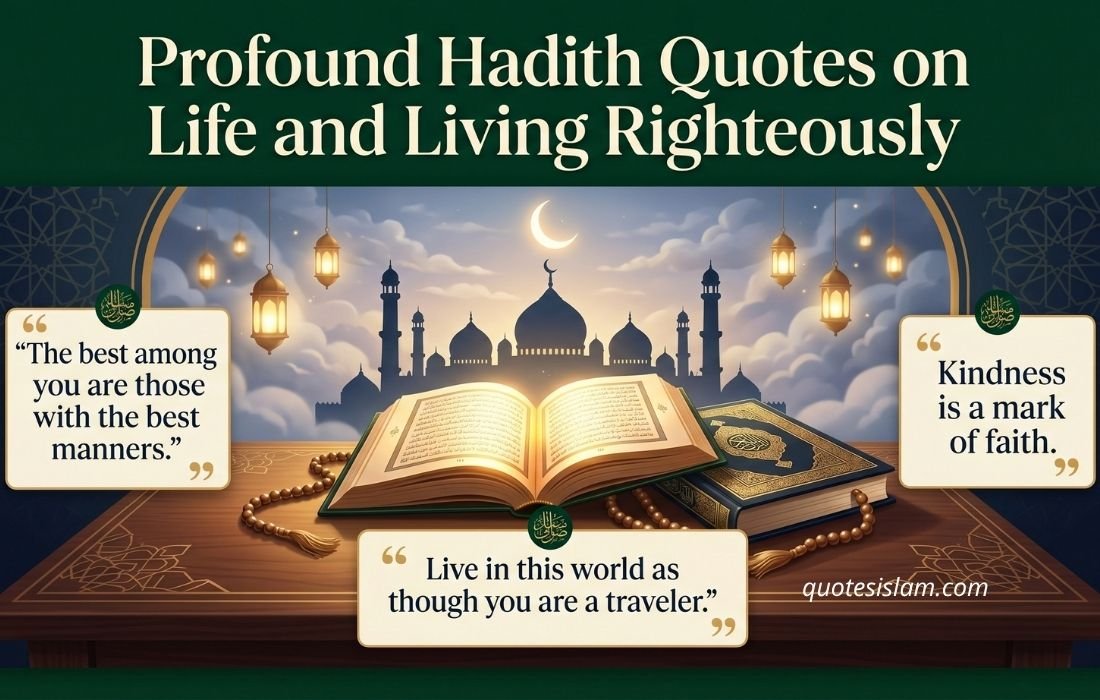
Beyond the Quran, many authentic Hadith also contain deeply inspiring Islamic quotes about life that help Muslims live with sincerity, compassion, and resilience.
The Hadith literature — collections of the Prophet’s authenticated sayings and actions — represents the second primary source of Islamic wisdom after the Quran. The most authoritative collection, Sahih Al-Bukhari, contains over 7,500 hadith narrations, each meticulously verified through chains of transmission.
Sayings of Prophet Muhammad (PBUH) on Daily Life
One of the most cited Islamic sayings about life reads:
“Take advantage of five before five: your youth before your old age, your health before your sickness, your wealth before your poverty, your free time before your preoccupation, and your life before your death.” — Narrated by Ibn Abbas, classified as Sahih
This remarkable quote functions as a complete life-planning framework. It urges you to act with urgency and intention — not out of anxiety, but out of conscious appreciation for what you currently possess. In practice, this hadith challenges the procrastination that quietly erodes so many people’s best years.
Hadith Wisdom on Character, Kindness, and Human Relationships
Prophet Muhammad (PBUH) said:
“The best of people are those who are most beneficial to others.” — Al-Mu’jam Al-Awsat, Al-Tabarani
This Hadith positions service to humanity as a cornerstone of a righteous life — not a supplement to it. That aligns directly with modern research: a Harvard Health study found that people who engage in altruistic behavior report significantly higher happiness levels and reduced rates of depression. Islam identified this truth long before the clinical literature caught up.
Consider a concrete scenario: a person who volunteers weekly at a food bank, motivated not by social recognition but by this prophetic principle, is simultaneously fulfilling a spiritual obligation and protecting their own mental health. The wisdom here is practical, not abstract.
How the Prophet’s Words Guide Muslims Through Life’s Trials
The Prophet’s personal response to tragedy is as instructive as any text. He lost children, endured persecution, and buried close companions — yet his response was captured in this statement:
“How wonderful is the affair of the believer, for his affairs are all good.” — Sahih Muslim
Islamic wisdom is not theoretical. It was lived, tested, and proven by the very person who conveyed it. That experiential credibility is precisely what separates these quotes from generic motivational content.
Islamic Quotes About Life, Hardship, and Resilience
Some of the most powerful Islamic quotes about life emerge not in moments of ease but in moments of collapse. Islam does not offer a sanitised version of human existence — it engages with suffering directly.
Finding Strength in Faith During Difficult Times
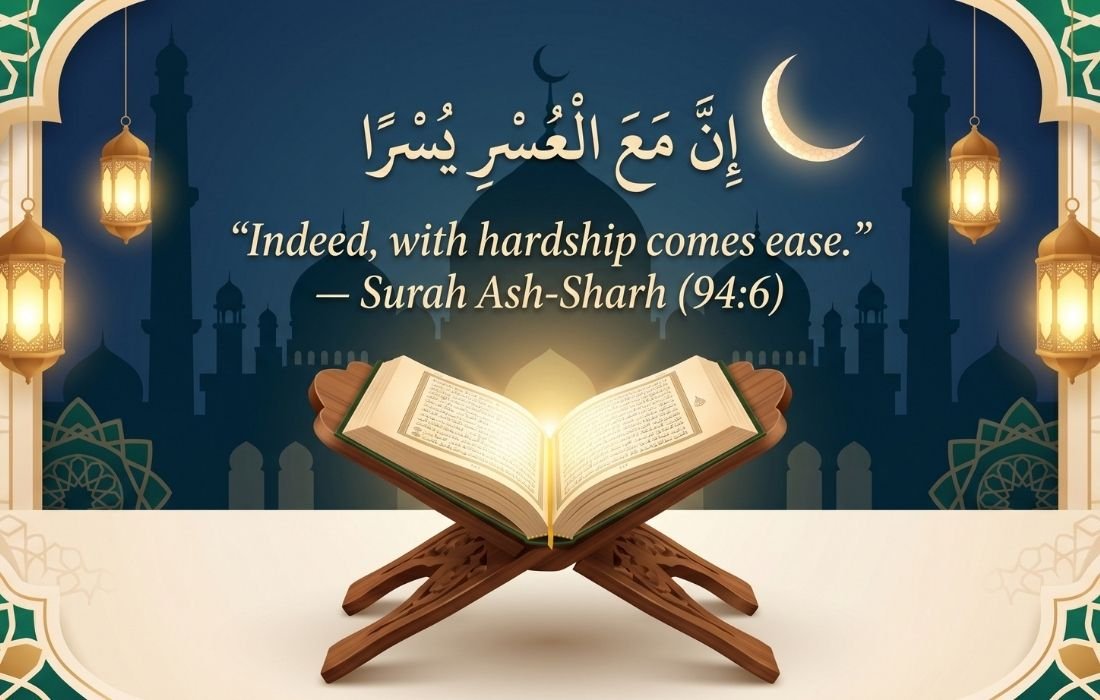
Surah Al-Inshirah (94:5–6) offers one of Islam’s most repeated reassurances:
“For indeed, with hardship will be ease. Indeed, with hardship will be ease.”
Notably, this verse appears twice in immediate succession — an intentional repetition that classical Islamic scholars interpret as a divine guarantee, not merely a consolation. The grammatical structure in Arabic reinforces the message: the word for “hardship” is definite, while “ease” is indefinite — meaning one hardship, but multiple forms of ease.
Quotes That Reveal the Purpose Behind Every Struggle
The Prophet (PBUH) taught:
“No fatigue, illness, anxiety, sorrow, harm, or sadness afflicts any Muslim, even if it were the prick of a thorn, except that Allah expiates some of his sins for it.” — Sahih Al-Bukhari
This reframing of suffering — as a means of spiritual purification rather than divine punishment — offers a genuinely powerful lens for processing pain. It does not minimise the reality of difficulty. It assigns meaning to it.
The Islamic View on Grief, Loss, and Emotional Recovery
What this means for you is that Islam does not demand stoicism. Prophet Muhammad (PBUH) wept at the death of his son Ibrahim, saying:
“The eyes shed tears and the heart feels grief, but we utter only what pleases our Lord.”
This example validates emotional expression while anchoring recovery in faith — a balance that contemporary grief counselors increasingly recognise as psychologically healthy. The permission to feel, combined with the discipline of not despairing, is one of the most sophisticated emotional frameworks in any religious tradition.
Islamic Quotes on Hope, Gratitude, and Contentment
Hope is not naivety in Islamic thought. It is a theological position — grounded in the character of Allah as Al-Rahman (the Most Merciful) and Al-Ghaffar (the Oft-Forgiving).
Embracing Gratitude as a Daily Islamic Practice
The Quran states in Surah Al-Araf (7:10):
“We have certainly established you upon the earth and made for you therein ways of livelihood. Little are you grateful.”
That final phrase is a provocation, not a condemnation. It invites you to audit your own gratitude — to notice what you overlook in the steady rhythm of daily life. In Islamic practice, the Alhamdulillah (“All praise is due to Allah”) uttered dozens of times daily is not a rote formula. It is a repeated recalibration of perspective.
Inspirational Islamic Sayings on Hope and Divine Mercy
Surah Az-Zumar (39:53) contains one of the most hope-filled verses in all of Islamic scripture:
“Do not despair of the mercy of Allah. Indeed, Allah forgives all sins.”
This verse directly combats hopelessness and self-condemnation — two of the most significant contributors to poor mental health — by grounding the believer’s self-worth in divine mercy rather than personal failure. For anyone carrying guilt or shame, these words function as both theological truth and emotional medicine.
How Contentment Builds Inner Peace in Islamic Teaching
Prophet Muhammad (PBUH) said:
“Richness is not the abundance of wealth, but richness is the richness of the soul.” — Sahih Al-Bukhari
This Hadith fundamentally decouples prosperity from materialism. That aligns directly with decades of subjective well-being research showing that beyond a baseline income threshold, additional wealth produces diminishing returns on happiness. Islam made this observation in the 7th century. Positive psychology confirmed it in the 20th.
Islamic Quotes About Life Goals, Success, and the Hereafter

One of the most common misconceptions about Islamic teachings is that they discourage worldly ambition. That reading is incorrect.
Balancing Worldly Ambition With Spiritual Priorities
Surah Al-Qasas (28:77) states explicitly:
“Seek, through that which Allah has given you, the home of the Hereafter; and do not forget your share of the world.”
This verse establishes a genuinely balanced philosophy — pursue excellence in this life while keeping the eternal perspective in view. Excellence in career, relationships, health, and community contribution is not in conflict with spiritual growth. According to Islamic teaching, it is an expression of it.
What True Success Means in Islamic Thought
The Quran defines ultimate success (falah) in Surah Al-Mu’minun (23:1–2):
“Certainly will the believers have succeeded — they who are during their prayer humbly submissive.”
Success, according to this definition, begins not in boardrooms or bank accounts but in the quality of your inner spiritual life. That is a radical repositioning of ambition — one that has guided Muslim entrepreneurs, scholars, leaders, and ordinary people alike for over a millennium.
Why the Hereafter Shapes How Muslims Approach This Life
The Prophet (PBUH) described this world’s relationship to the afterlife with striking clarity:
“What is the life of this world but play and amusement? But best is the home in the Hereafter, for those who are righteous.” — Surah Al-An’am (6:32)
That is not a dismissal of this life — it is a proportionality statement. It keeps temporary pleasures and temporary pains in their correct scale, preventing both reckless indulgence and paralyzing despair.
How to Apply Islamic Life Wisdom Every Day
Understanding these quotes is step one. Living them is the harder work. Here is a practical framework drawn directly from the teachings above:
- Start each morning with intention (niyyah). Before checking your phone, articulate what you are doing that day and why — aligning your actions with purpose.
- Practice daily shukr (gratitude). Name three specific things you are grateful for, drawn from the areas of health, relationships, and circumstance.
- Reframe difficulty using the lens of sabr. When hardship arrives, ask: what is this developing in me? What is being purified?
- Measure success weekly against falah, not just productivity. At the end of each week, ask whether your inner life improved — not just your output.
- Serve someone without expectation. Acting on the prophetic principle that the best people are the most beneficial to others produces measurable psychological and spiritual reward.
These are not abstract ideals. They are daily habits rooted in 1,400 years of tested wisdom.
Applying Islamic quotes about life consistently can help believers develop a stronger mindset and deeper faith.
Key Takeaways
These timeless Islamic quotes about life continue to inspire millions of people to live with faith, patience, gratitude, and trust in Allah.
These Islamic quotes about life provide guidance for building patience, faith, and emotional strength in daily life.
- Islamic quotes about life draw from two primary sources — the Quran and the authenticated Hadith — offering a complete framework for purpose, resilience, and contentment.
- Quranic verses on sabr (patience) and shukr (gratitude) align with modern positive psychology research, confirming their practical as well as spiritual value.
- The Prophet Muhammad’s (PBUH) personal conduct during hardship demonstrates that Islamic wisdom is experiential, not merely theoretical.
- Islam does not reject worldly ambition — it contextualises it within an eternal framework, producing balanced, purpose-driven living.
- These teachings are most powerful when applied daily through intentional habits, not treated as decorative inspiration.
Frequently Asked Questions
What are the most powerful Islamic quotes about life from the Quran?
Among the most powerful Quranic quotes on life are Surah Al-Baqarah (2:286) — “Allah does not burden a soul beyond that it can bear” — and Surah Az-Zumar (39:53) — “Do not despair of the mercy of Allah.” These verses address suffering, hope, and personal capacity with a directness that has sustained believers across fourteen centuries. For daily use, Surah Al-Inshirah (94:5–6), which repeats the promise that ease accompanies hardship, is among the most cited.
How do Islamic quotes about life differ from general motivational quotes?
The core difference is grounding. General motivational quotes are typically author-attributed perspectives, while Islamic quotes draw from the Quran — believed by Muslims to be divine revelation — and from the authenticated sayings of a Prophet whose life was documented in extraordinary detail. This means they carry theological authority, historical context, and a 1,400-year track record of practical application. They also address the full spectrum of life — not just success, but grief, failure, sin, and death — without sanitising any of it.This is why Islamic quotes about life continue to inspire millions around the world.
Can non-Muslims benefit from Islamic wisdom quotes about life?
Absolutely. The universal themes within Islamic teachings — patience, gratitude, purposeful living, resilience, and service to others — resonate across religious boundaries. Many of the principles in Quranic verses and Hadith literature parallel findings in modern psychology, philosophy, and ethics. Scholars from Rumi’s Sufi tradition to contemporary thinkers have drawn on these teachings regardless of their own faith backgrounds. The wisdom is explicitly about the human condition — and that belongs to everyone.
Conclusion
In the end, Islamic quotes about life are far more than inspirational words. They are divine reminders and practical lessons that guide Muslims through happiness, hardship, success, and loss. By reflecting on these Islamic quotes about life daily, believers can strengthen their faith,These Islamic quotes about life also remind people to stay patient, grateful, and connected to Allah in every situation. improve their mindset, and find peace in every stage of life.For anyone seeking peace and direction, Islamic quotes about life remain a timeless source of wisdom and inspiration.Islamic quotes about life continue to guide believers toward a balanced and meaningful way of living.